
Witchcraft in Spring

The floating lace caps of cow parsley line all the pathways, like wedding guests showering delicate confetti as you pass along their aisle of cracked earth. Even the road to school is lined with horse chestnuts holding aloft their pink and white candles in some glorious pageant. Along the stream to the Paradise Pool the fluffy seeds of willow float about like snowflakes and lie in drifts on the path, eddying into fairy foam on the surface of the water. We spent a lot of time there last weekend; a harbour was built for a small ship carrying grey rock flecked with quartz across the great Paradise Sea, while Mouse slept quietly in her diminutive carriage pram. The skinny whippet reappeared at intervals, legs coated in black mud.
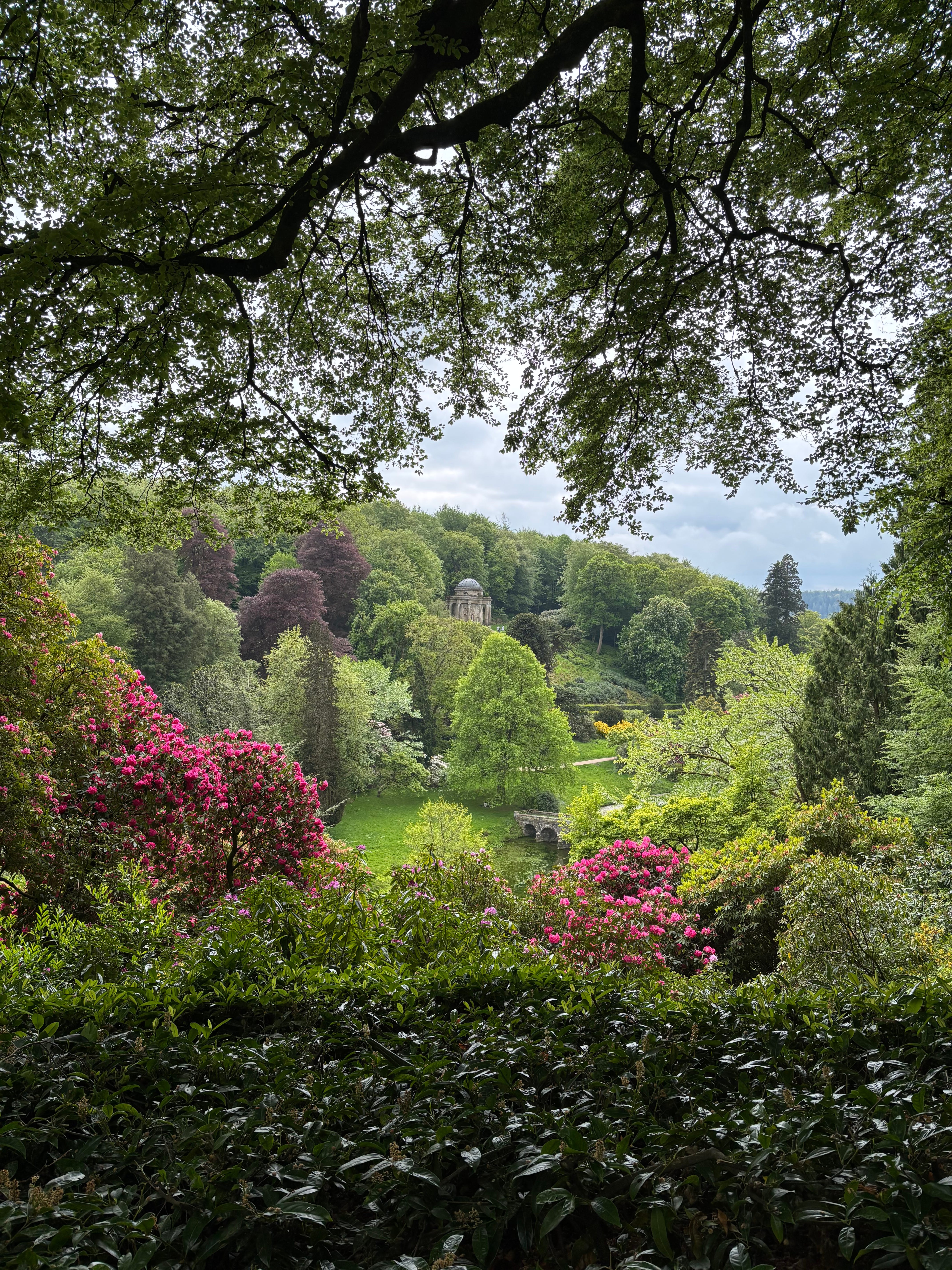
Stourhead’s vistas were more perfect than ever when we visited recently, punctuated with bright magenta clouds of rhododendrons, a haze softening the edges with exaggerated aerial perspective as if painted by Claude. A swan obligingly sailed across the lake.
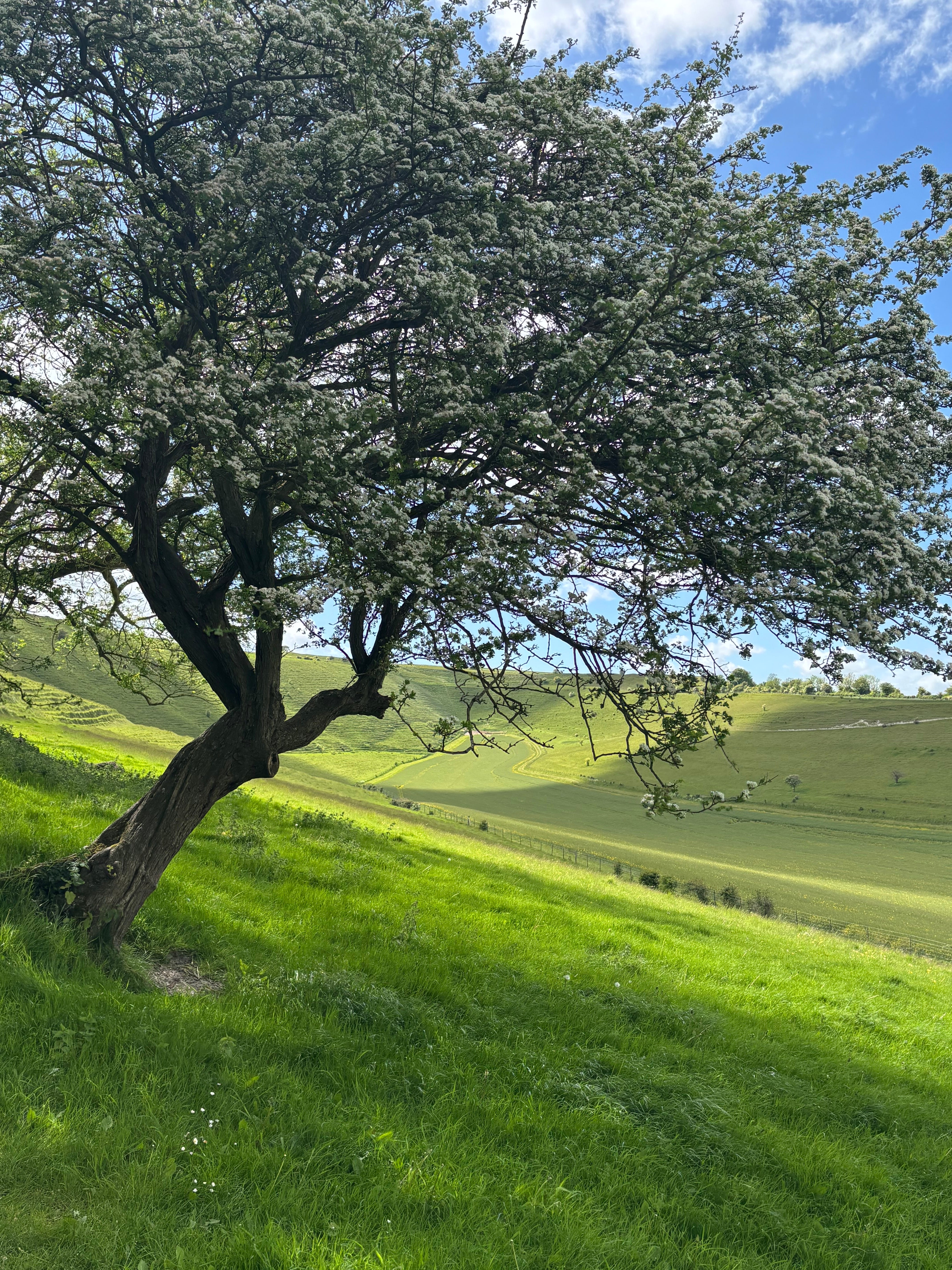
Spring seems full of nature’s alchemy - almost unbelievable tableaux summoned from the bare twigs and earth of mere months ago. Liz Gwedhan wrote recently on Substack about Hawthorn, the magic of May blossom and its accompanying superstitions:
‘Haw’ comes from the Old English word ‘Haga’ meaning an enclosure, or the hedge which forms it... So a hawthorn is a ‘hedge thorn’ etymologically speaking. It’s a tree of edges and gateways.
The word ‘hag’ meaning an old woman, has the same origin as ‘haga’, and is descended from the Middle English word ‘hægtis’ and which means a female witch or soothsayer. I like the idea that the ‘hag’ was perhaps someone who lived by the ‘haga’ - that is in the liminal space between the settled ordered world and the wild land beyond - and so by analogy, between the known and the unknown world. There is a strong word association then, between hawthorns, hedges and witches.
Witches were often just women who had an arcane knowledge of the use of plants to cure, heal - or poison. They were often the doctors or midwives in a community, but when something inexplicable happened - a mysterious death, crop failure - they were accused of malevolent magic. There are beautiful descriptions of Agnes’s innate knowledge of plants and their natural powers in Maggie O’Farrell’s Hamnet:
‘Agnes has a patch of land at Hewlands, leased from her brother, stretching from the house where she was born to the forest. She keeps bees here, in hemp-woven skeps, which hum with industrious and absorbed life; there are rows of herbs, flowers, plants, stems that wind up supporting twigs. Agnes’s witch garden, her stepmother calls it, with a roll of her eyes. Agnes can be seen, most weeks, moving up and down the rows of these plants, pulling up weeds, laying her hand to the coils of her hives, pruning stems here and there, secreting certain blooms, leaves, pods, petals, seeds in a leather bag at her hip.’
Last weekend we took part in a Young Curator’s Club where the theme was medieval medicine, and the participants wrote out their cures for various maladies with a quill pen, then mixed up potions of herbs in a pestle and mortar. We did not try them out - we were all too healthy, no sores or gout to be seen. Next, lavender bags were created as modern pomanders; what an odd notion that so long as you, personally, were inhaling the scent of dried lavender, no evil plague-ridden air could get up your nose. I was reminded just how many natural remedies we use still, mainly in tea infusions or balms. When child B complains of achy bones after a heavy session at the playground I give her daisy balm; and when child A keeps biting his top lip until he looks like he has developed impetigo and refuses all salves, I find myself creeping up to his attic room in the dead of night to apply a beeswax concoction from Pluscarden Abbey to his sleeping features, suppressing a cackle at my ingenuity.
I first read Lolly Willowes by Sylvia Townsend Warner just over a year ago and it offers quite a different view of witches - for the protagonist, joining the coven is a means of breaking free from the societal expectations that governed unmarried women in the early 20th century. After her father dies, she is then dependent on her brother, who seems to embody the patriarchy; Satan, meanwhile, is conceived as a ‘loving huntsman’ who allows her autonomy, adventure and empowerment in the natural world.
‘That’s why we become witches: to show our scorn of pretending life’s a safe business, to satisfy our passion for adventure. It’s not malice, or wickedness… One doesn’t become a witch to run around being harmful, or to run around being helpful either, a district visitor on a broomstick. It’s to escape all that - to have a life of one’s own, not an existence doled out to you by others, charitable refuse of their thoughts…’
Sometimes, at this time of year, I glance out of the window before going to bed and see a thin streak of pink still glowing on the horizon, the roses still shimmering in the garden below, and the mysterious world of the dusk seems to be calling me out. There is something about this season with its rebellious growth that is delightfully subversive.
‘The night was at her disposal. She might walk back to Great Mop and arrive very late: or she might sleep out and not trouble to arrive till tomorrow… Lovely to be with people who prefer their thoughts to yours, lovely to live at your own sweet will, lovely to sleep out all night!’
It is a somehow very apposite connection isn't it - I was so interested to read Liz's post.
Love the etymology of hawthorn to edge, and the possible connection to old woman/witch — that liminal figure at the boundary feels right even if the linguistic link is contested.